Earl Stonham
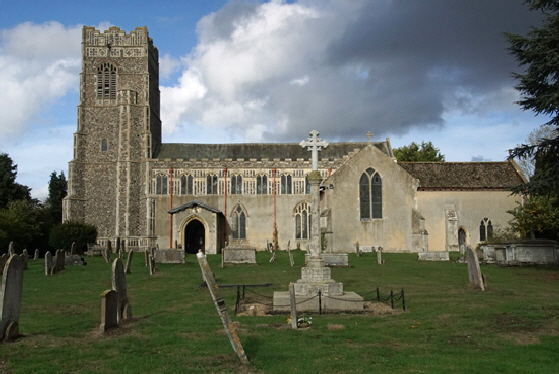
Earl Stonham, Suffolk
I went to this church with my friend, Bonnie Herrick-Killingback. She uses an incredibly long lens and a tripod to enable long exposures and pin-sharp photographs. In any joint trip we make I will take four times more (hand-held) pictures than her and hers will be twice as good. And she will go back without me to spend hours taking all the ones she had no time to take when accompanied by my less patient self. When I saw her pictures of the roof here I was stunned. In all sincerity I said that probably nobody had ever recorded it better and that the photographs deserved a proper audience. That audience, dear reader is YOU. I have decided to showcase Bonnie’s pictures on this page alongside my own more numerous but inferior efforts.
Like so many churches in this area, the first impression is of size. The second, sadly, is of disappointment. The tower and the south face of the clerestory are good examples of fine Suffolk flint architecture and flushwork. The lower part of the nave and all else besides have been despoiled by a coating of cement. It is horrid and unforgivable. Unusually, it is a cruciform plan with no aisles and with two transepts but the tower is to the west, not in the centre as would have been the case with most Norman and Early English cruciform churches. Yet, this is a church that had Early English antecedents as witnessed by a lancet window in the chancel. All else that we see is obviously style, probably of the mid-fifteenth century. Apart from the clerestory and west tower, then, the church is of no real architectural merit. The interior is another matter!
This is not the lightest of churches and I wonder how many visitors have stuck their heads through the door, glanced around, written a vacuous “Beautiful” or “Peaceful” in the Visitors Book (to distinguish if from all those riotous and noisy churches they sometimes encounter) and gone to the pub? When I take a group of people church visiting one of my first pieces of advice is “always look up” and never has a parish church so well born out this advice. Yet the light is low and you might still miss what a wonderful thing it is. Binoculars or a long lens are very necessary here.
It is a classic hammerbeam roof with collars. The collars all have pendants as do the hammerbeams themselves. Every other hammerbeam is a carved angel. The angels, in fact, have been defaced but don’t let that worry you. In the spandrels you will see wonderful foliage and animalistic carvings, The pendants have hidden human faces and everywhere you look you are liable to spot something decorative and interesting. The very construction is a thing of fascination. With a good lens you can detect the complexity of all, and the ingenuity of the carpenters.
Above the chancel arch are fragments of a doom painting and there are other such fragments to be seen elsewhere in the church. The font is a fine one, although the subject matter is perhaps rather run-of-the-mill. In the chancel there are fine bench carvings including a really impressive bagpiper. Let’s take a look.
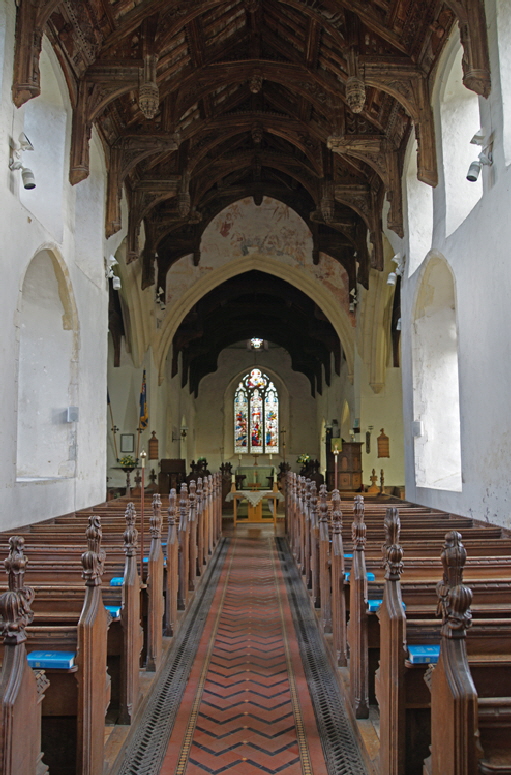
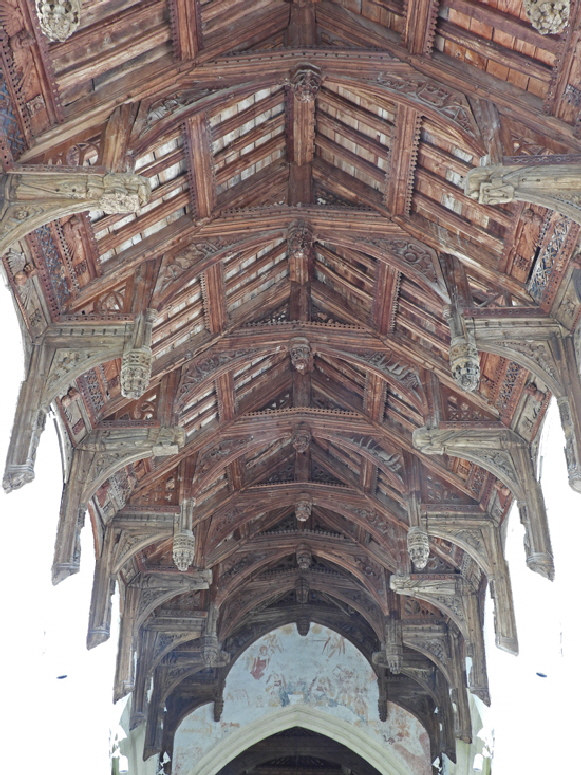
Left: Looking east down the nave. As with several photographs on this page, I have had to use Photoshop to “lift” the shadows since the roof area is quite gloomy despite the large nave windows. The view is uninterrupted by any screen. Right: (Photo: BHK): This is Bonnie’s view of the roof, looking east. Again. I have had to lift the shadows so this is not precisely the picture Bonnie took. There are recumbent angels on every other hammer beam. Where there is no angel the carpenter has carved a pendant at the foot of the strut (the uprights above the hammerbeams). Each of the collars (the transverse beams) has a pendant. Each spandrel (the curved in-fill between the wall post and the hammerbeam) has a carved design, It is there that we find the most entertaining imagery. The spandrels between crowns and struts are also carved. The horizontal areas between the hammerbeams - the wall plates - also have carved designs with two rows of strangely feathered angels.
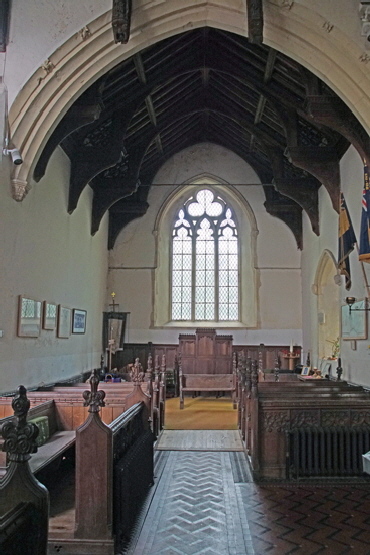
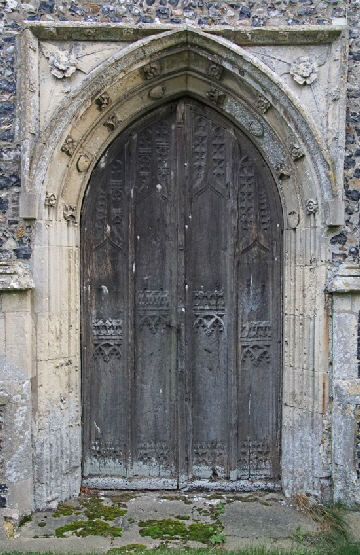
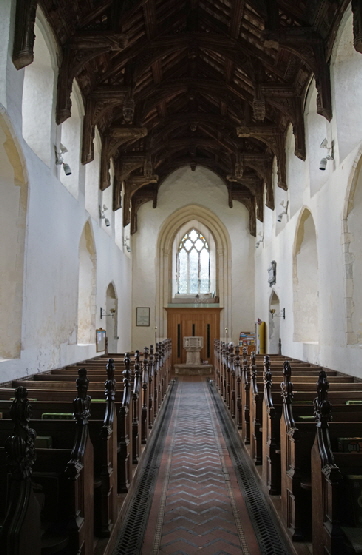
Left: Looking to the west. The west window is in Decorated style. As this pre-dates the tower so Pevsner avers that it was originally the west window of the original cruciform church. The roof looks darker in this picture but it is even darker in reality! To be fair, there are lights but even darkness is easier to cope with in a church than electric light! Centre: The north transept. Right: The west doorway, The door itself is particularly fine and mediaeval. There are two courses of carved decoration and floral designs within the spandrels.
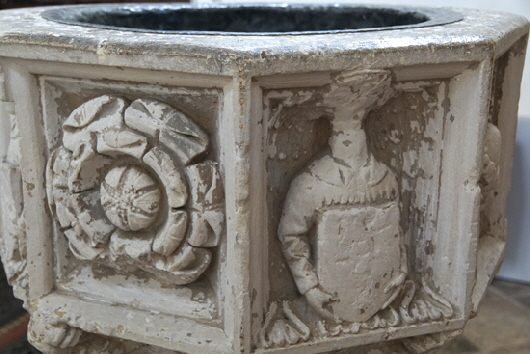
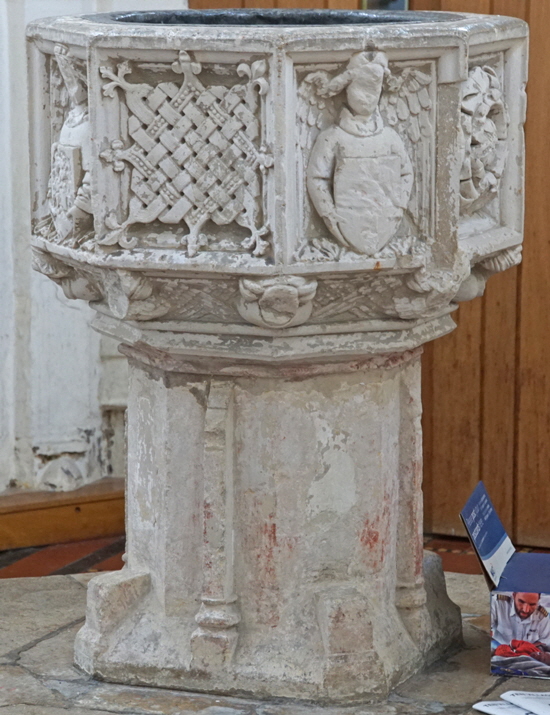
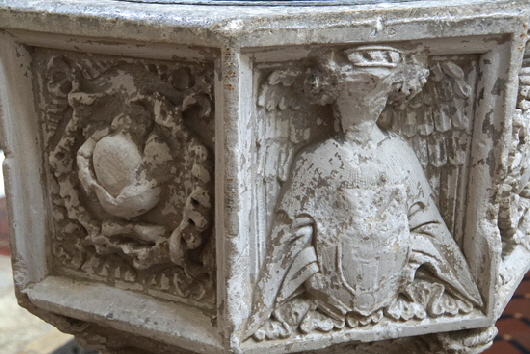
The font: First, note the vestiges of paint on the stem. At each corner there was a figure that has been removed at some point,. Were they “inappropriate” images such as we see at Norton also in Suffolk? The angels seem to have been defaced as well, sadly.
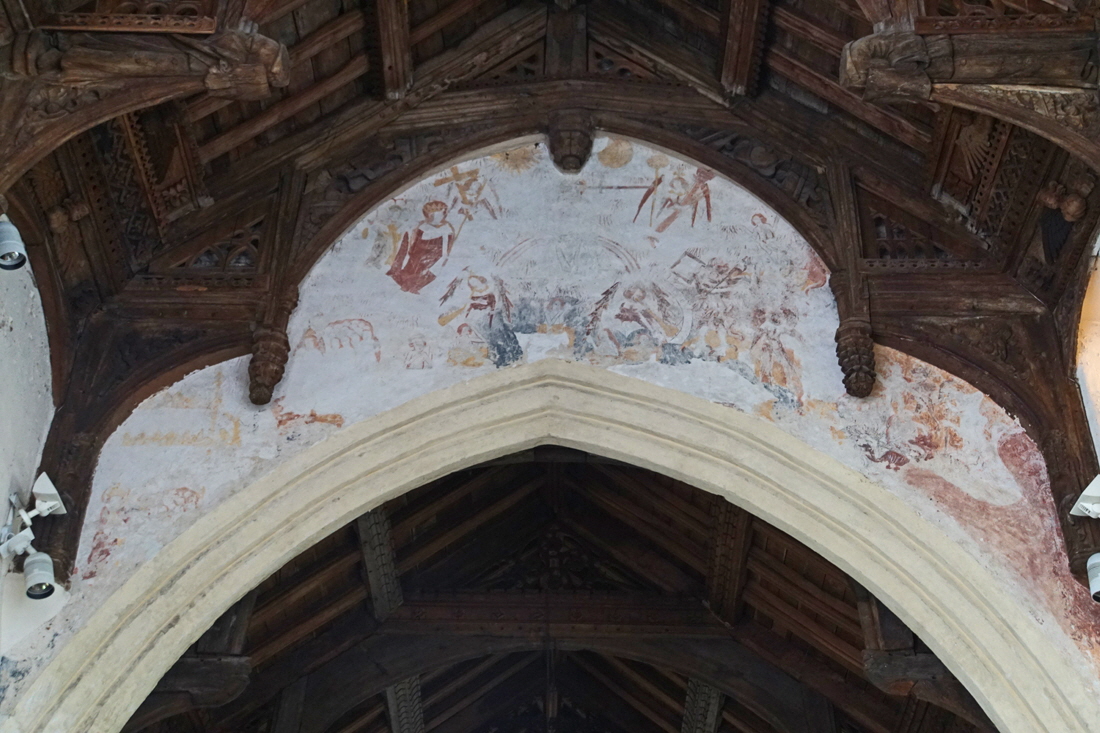
The doom painting over the chancel arch. As usual, all of the mayhem is on the south (right) side where the devils and demons are doing nasty things to the sinners.
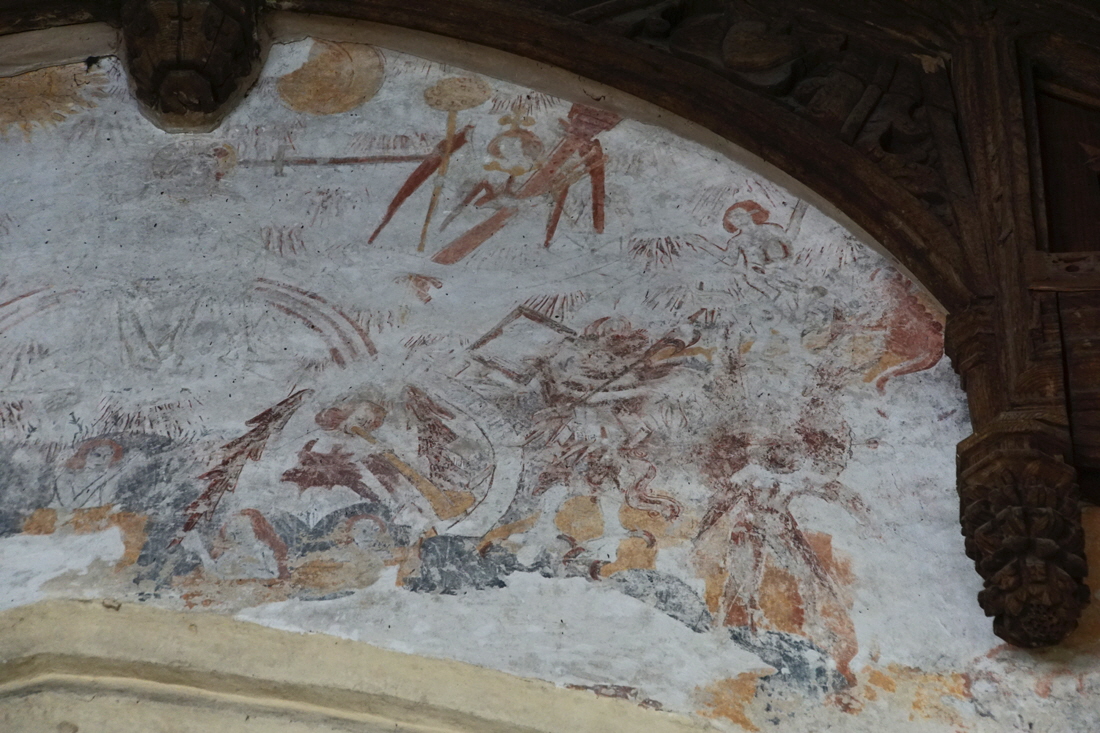
The sinner side,. Just about discernible to the right are two large demons. Sadly, we can’t see too much of the wretches that were depicted below their feet (see artist’s impression below. This is a doom painting that is heavy on the angelic stuff so a couple of them are flying around at the top here/
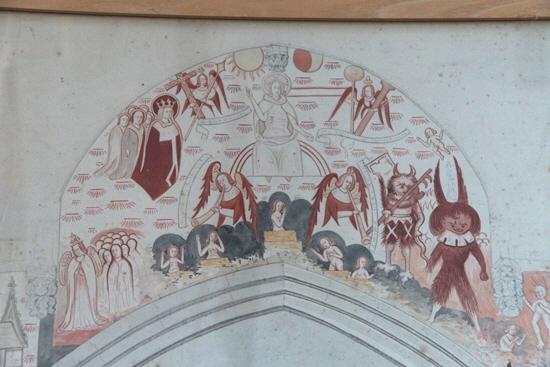
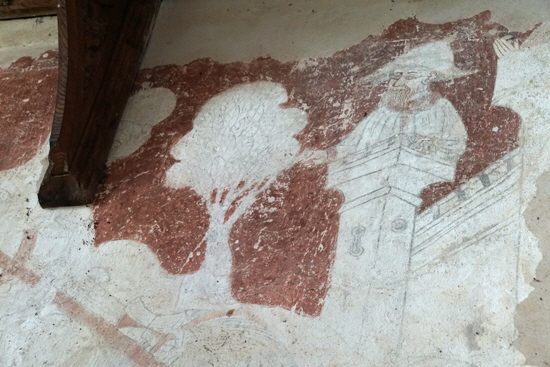
Left: An artists impression of the doom paining. It looks incredibly naive to me with comic book demons that look less ferocious even than the remaining fragments. At the bottom, the judged are emerging from their coffins. Bottom left, the saved are led off to Heaven looking suitably virtuous. This is in truth a very flat and unvibrant doom - albeit not quite as well mannered as the “reproduction” here. Right: Another fragment of wall painting,
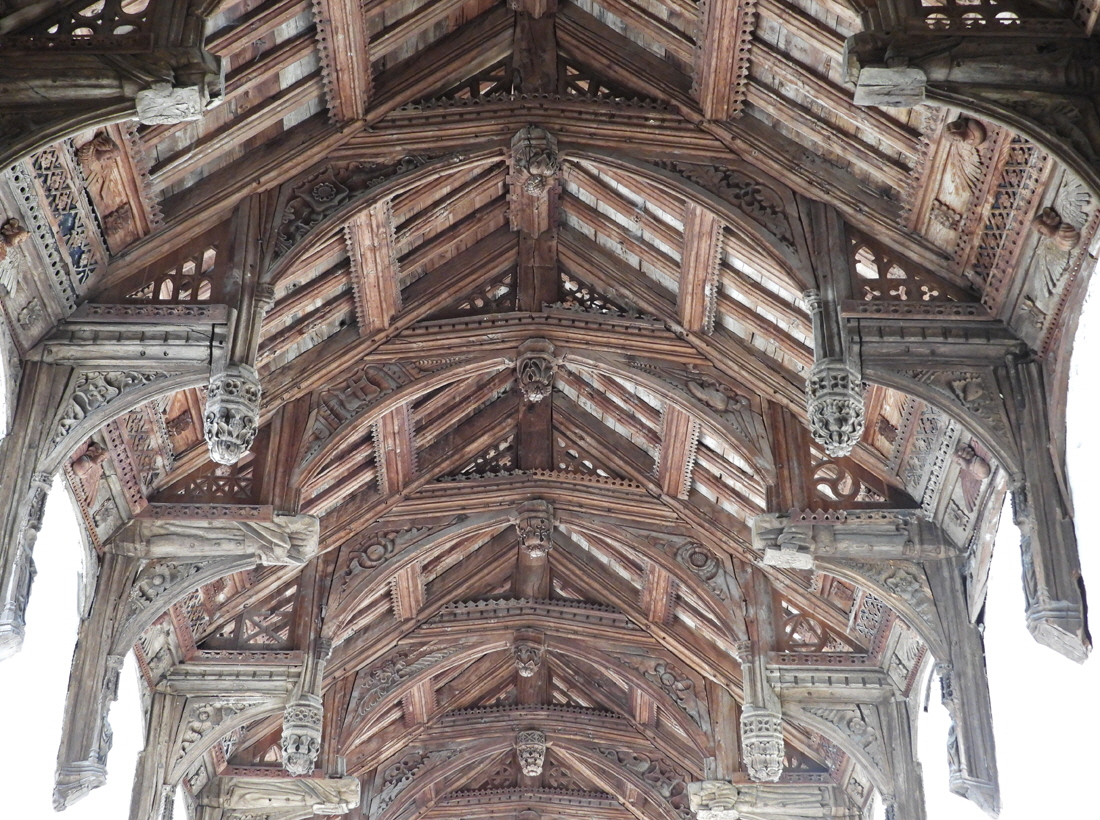
More detail of the roof. Everywhere you look there are decorations. Do not overlook the complexity of the overall structure and the ingenuity of the joinery. Photo: BHK
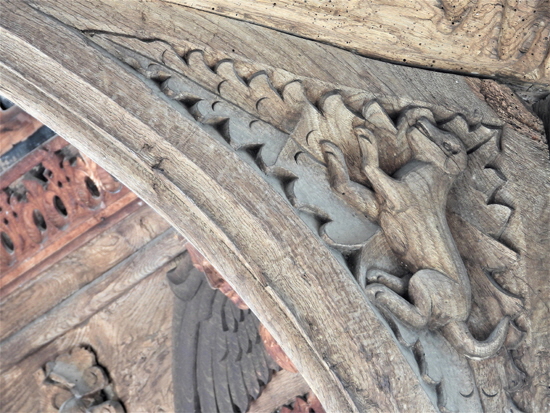
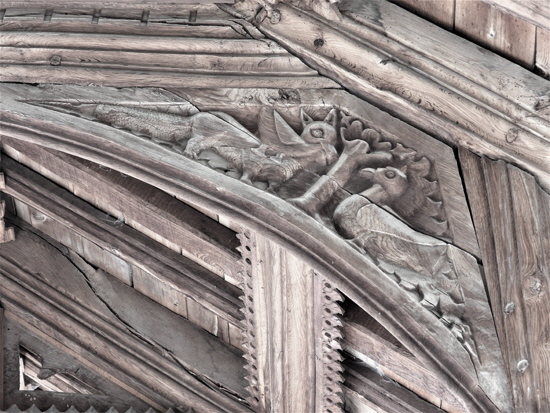
The spandrels are the site of the most entertaining decorations and almost impossible to see unless you know where to look and have long distance optics. Here, Bonnie Herrick-Killingback has captured what may be a dog (left) and (right) a fantastic creature and a bird facing each other between a tree. Photos both BHK.
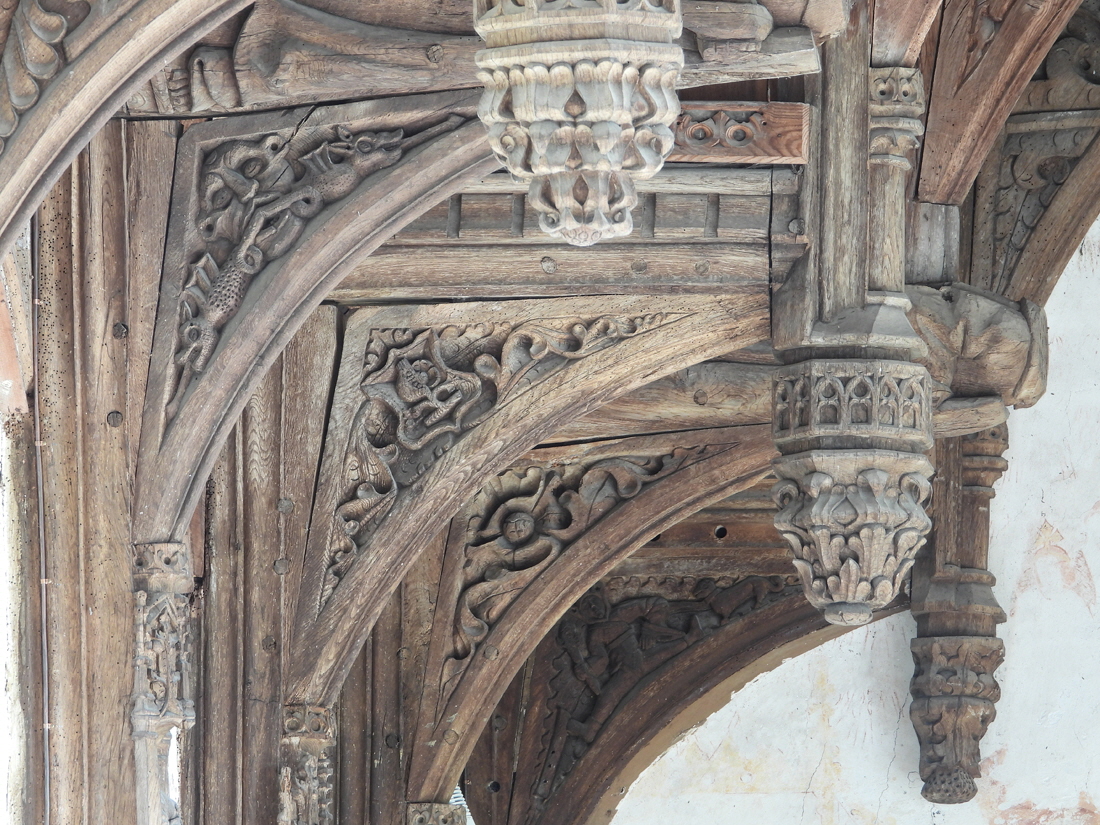
My favourite of Bonnie’s pictures. Four spandrel decorations can be seen here. Nearest to us we can see a man’s mouth spawning two dragon-like creatures, presumably his lies. Then we see a stylised design of intricate foliage. Behind that is a flower - probably a rose. Beyond that is a superb carving of a jester shown below. One of the prone angels can be seen towards the top of the picture. Note the pendants. Rather like a Giles cartoon, this picture invites you to keep looking in the hope of finding some detail you might have missed. Note the many wooden pegs that hold the structure together. Photo: BHK
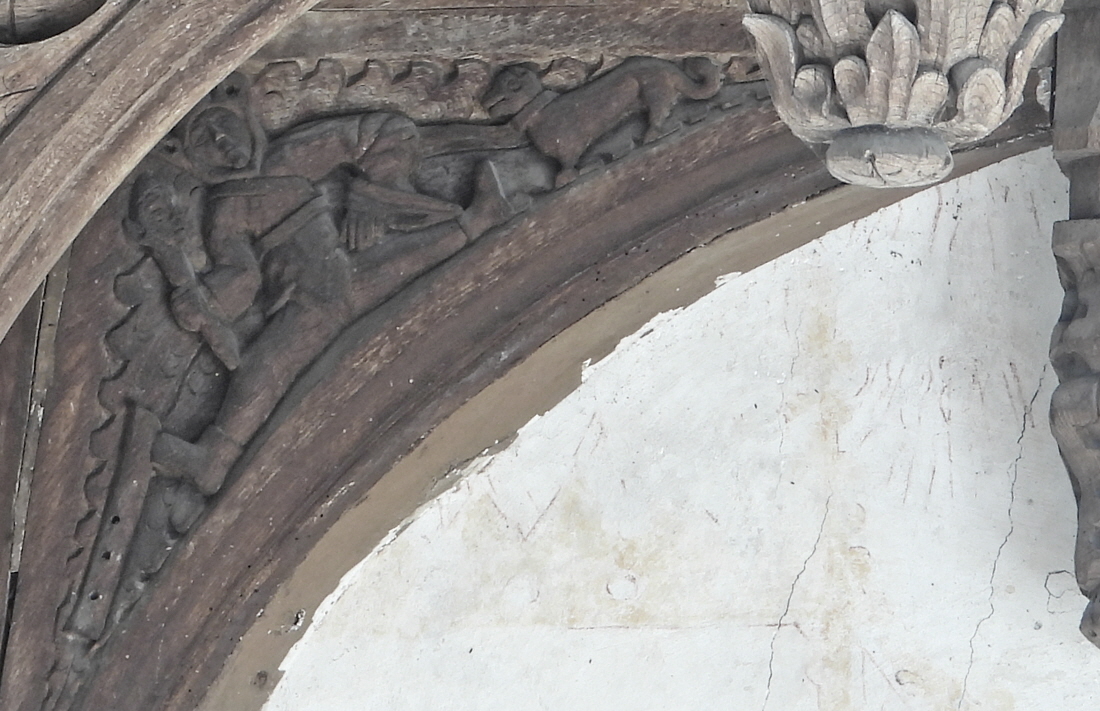
I was able to extract this image of the jester from Bonnie’a larger picture above, which gives you some idea of the power of the zoom lens she uses and of the benefits of using a low ISO setting (100 is her norm) and very long exposures. If this carving was done today we would say it was text book image of the jester, Yet, in fact, it is mediaeval imagery like this that informs our text books! His hat has asses ears. In his right hand he clutches his jester’s doll. His dog is at his left side and his flute to his left. He is a doing the splits showing his contortionist skills. Photo: BHK
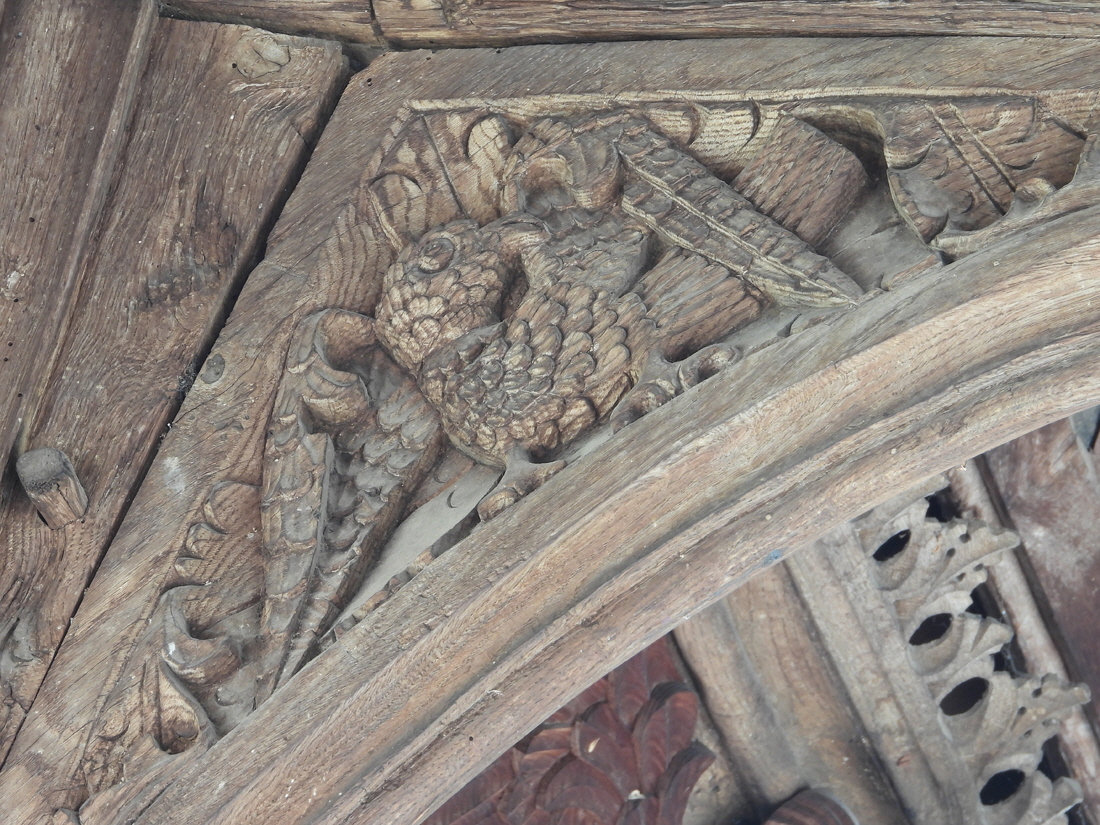
An eagle sits on a branch. Photo: BHK
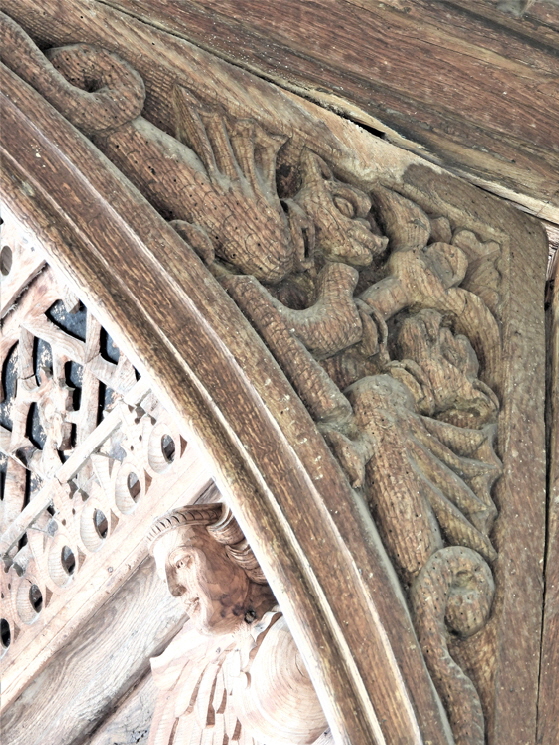
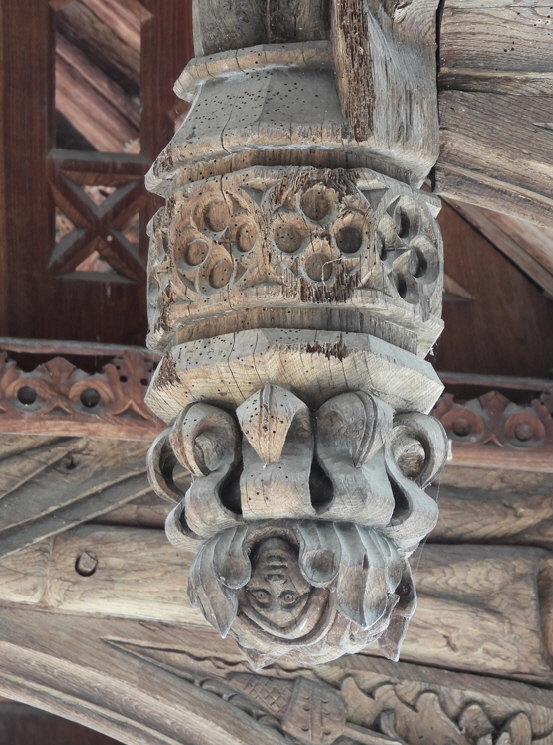
Left: Two dragons face off either side of a tree . Note they are both chained by the neck to the trunk. Right: You have to loo very carefully indeed to spot that some of the pendants have human faces showing. This one in fact has them on all four sides. Bonnie was annoyed with this picture because there is a woodworm crawling out of one of the holes and she says it is ever-so-slightly out of focus. Tsk, Bonnie. Photos Both BHK
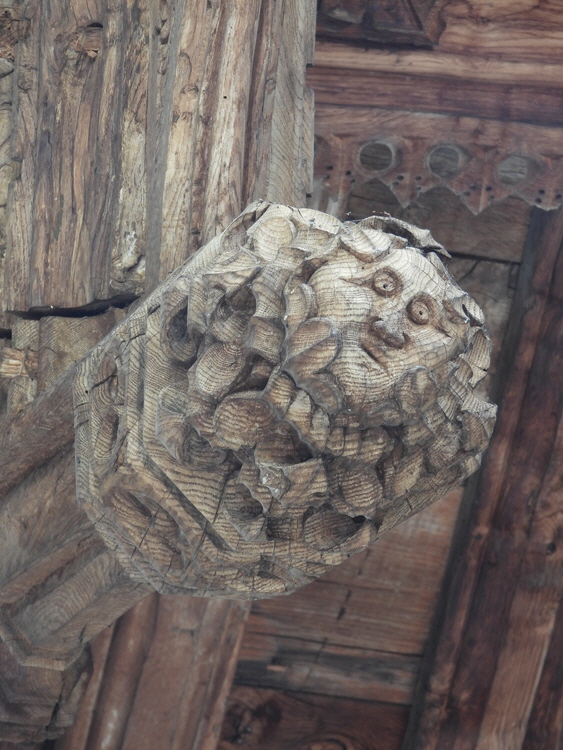
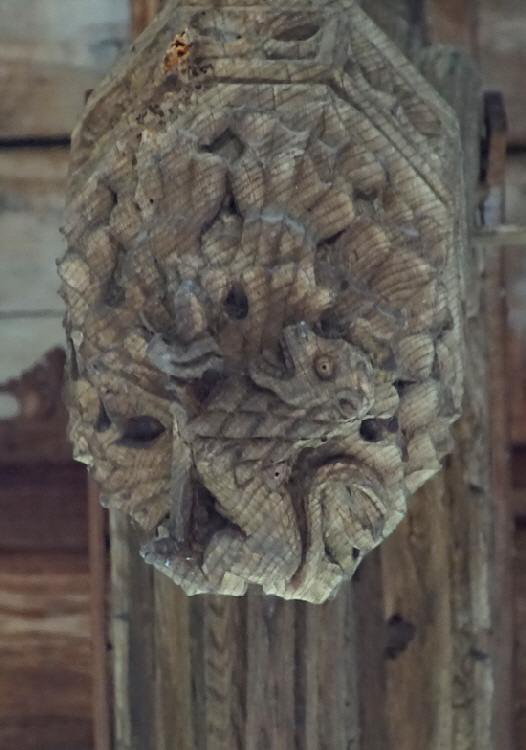
The Parable of the Patient and the Impatient. Left: Photo: BHK. Another from Bonnie, showing a Green Man peering out of one of the pendants. ISO100 , f5 aperture at 1/5 second using a tripod without which these settings would have been impossible. Right: Photo: LW. One from myself, hand held, at the extreme length of my 18-270mm Tamron zoom. Using my “Hand-held Twilight” setting, this picture is taken with a once-unimaginable ISO6400, f6.3 aperture at 1/30 second. I wonder why Bonnie’s picture is much sharper than mine? She would, I know, have deleted my picture as being not good enough and then returned to the church a few weeks later to take it again! Note how much more background detail Bonnie’s picture has compared with mine. But then I shoot ten pictures for every one of hers and Bonnie didn’t spot this dragon at the end of a pendant.
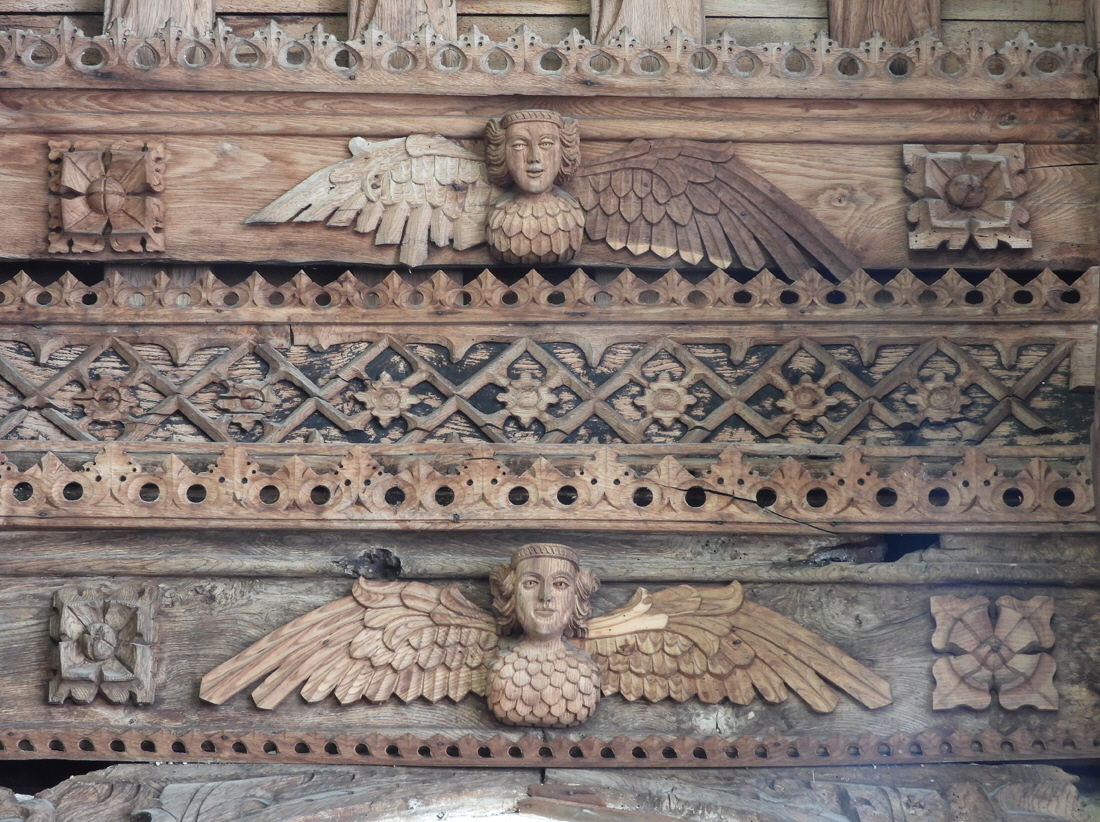
A section of wall plate showing feathered angels. Note the fineness of the decorative courses. Photo: BHK
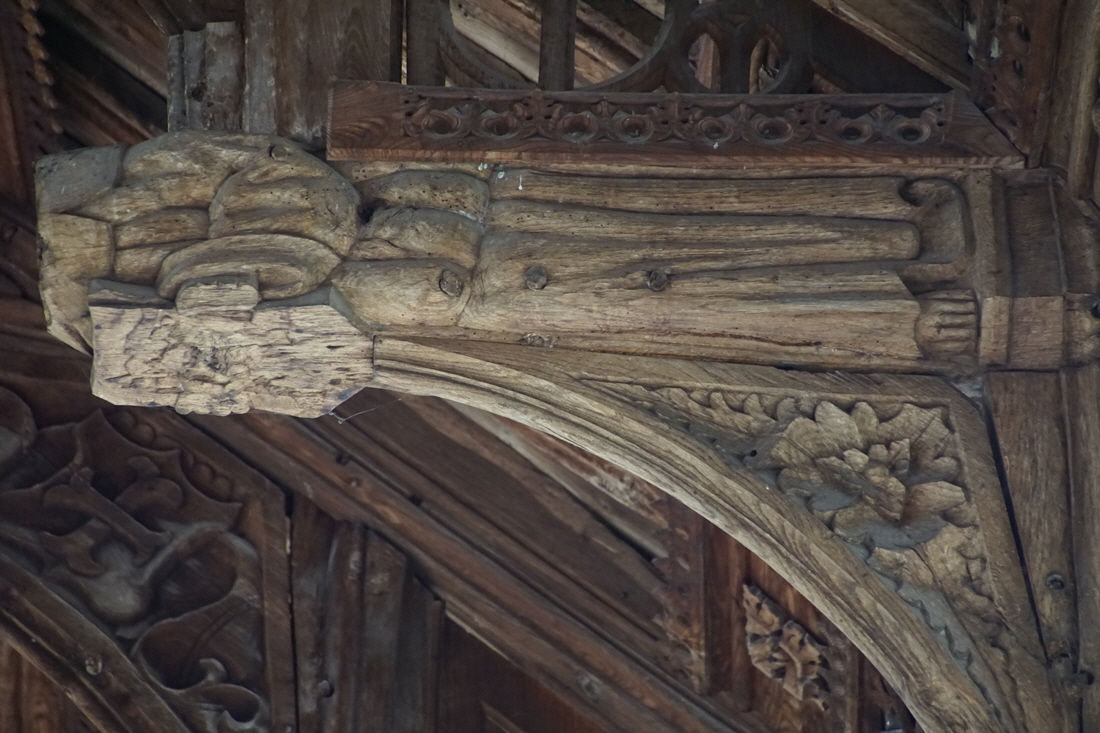
Left: One of the recumbent angels. All had their heads removed, presumably in a fit of inconoclastic madness, since many angel roofs have survived unmolested throughout the East of England. Or maybe the villagers forgot to hide their long ladder? The feet are oddly positioned. There is foliage in the spandrel. Photo: LW
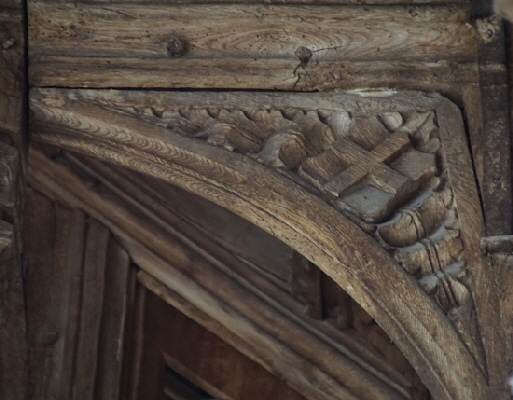
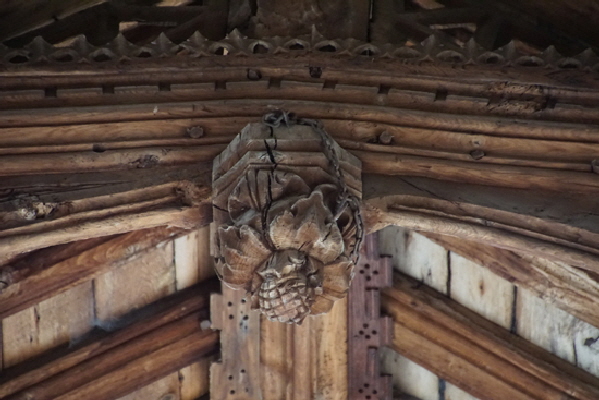
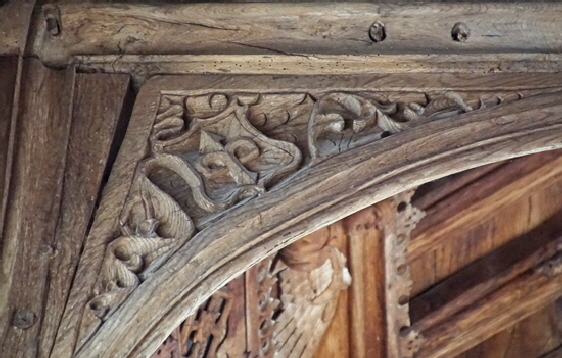
Left: A spandrel bearing a coat of arms with a cross, surrounded by foliage. Right: One of the collar pendants. Photos: Both LW
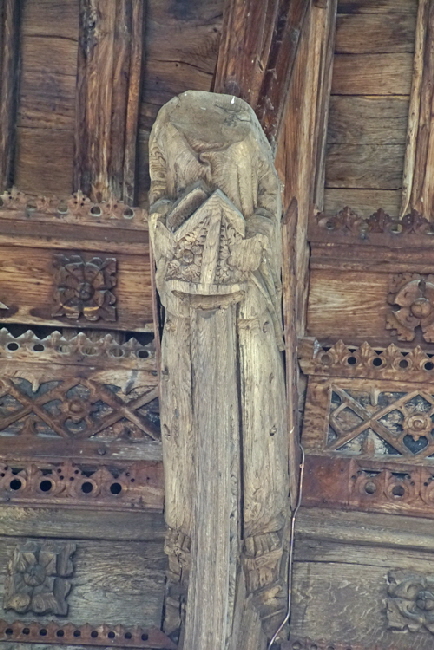
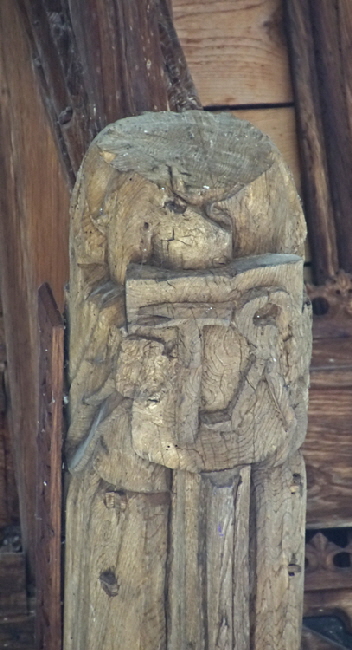
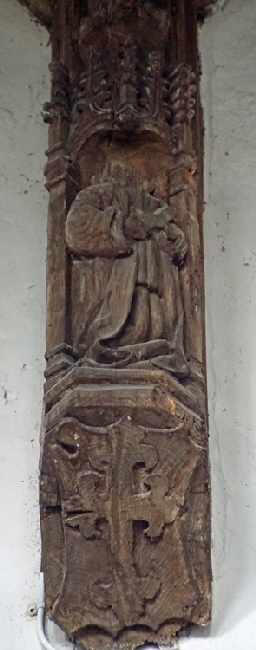
Left: Angel bearing a bishop’s mitre. Centre: An angel bearing a shield showing two of the Instruments of the passion. Right: One of the carved wall posts of the roof. These too have been defaced. Photos: All LW
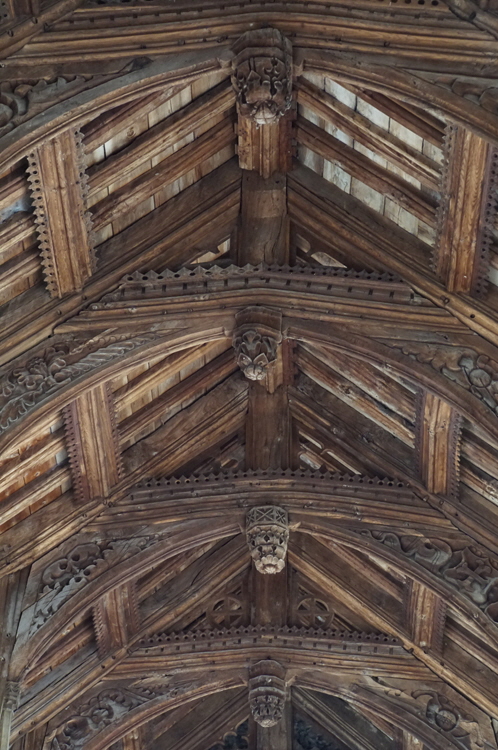
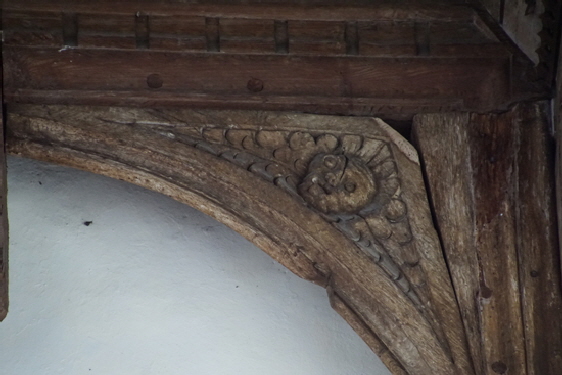
Left: A view along the nave roof, showing the pendants on the cross members and a view of more stylised spandrel carvings. Note the geometric carvings in the spandrels between the crown members are the sloping roof timbers. Right Above: A face peers out from foliage. Right Lower: A shield with fleurs de lys. Photos: All LW
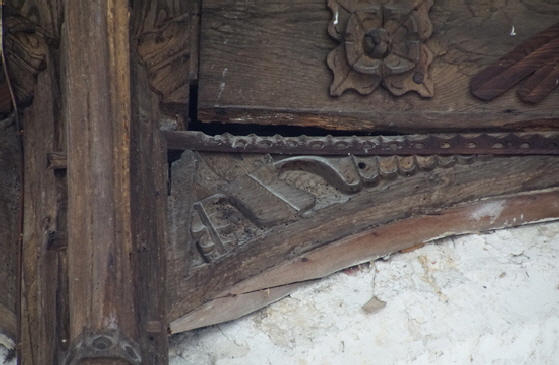
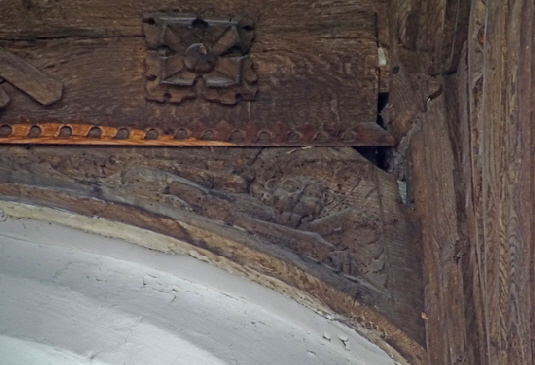
Under the roof’s wallplates are some more carvings. Left: It’s hard to make this out. Is it a monogram of one of the carpenters? Right: If you look very carefully, you will see that this is a lion sticking his tongue out at the world. Photos: Both LW
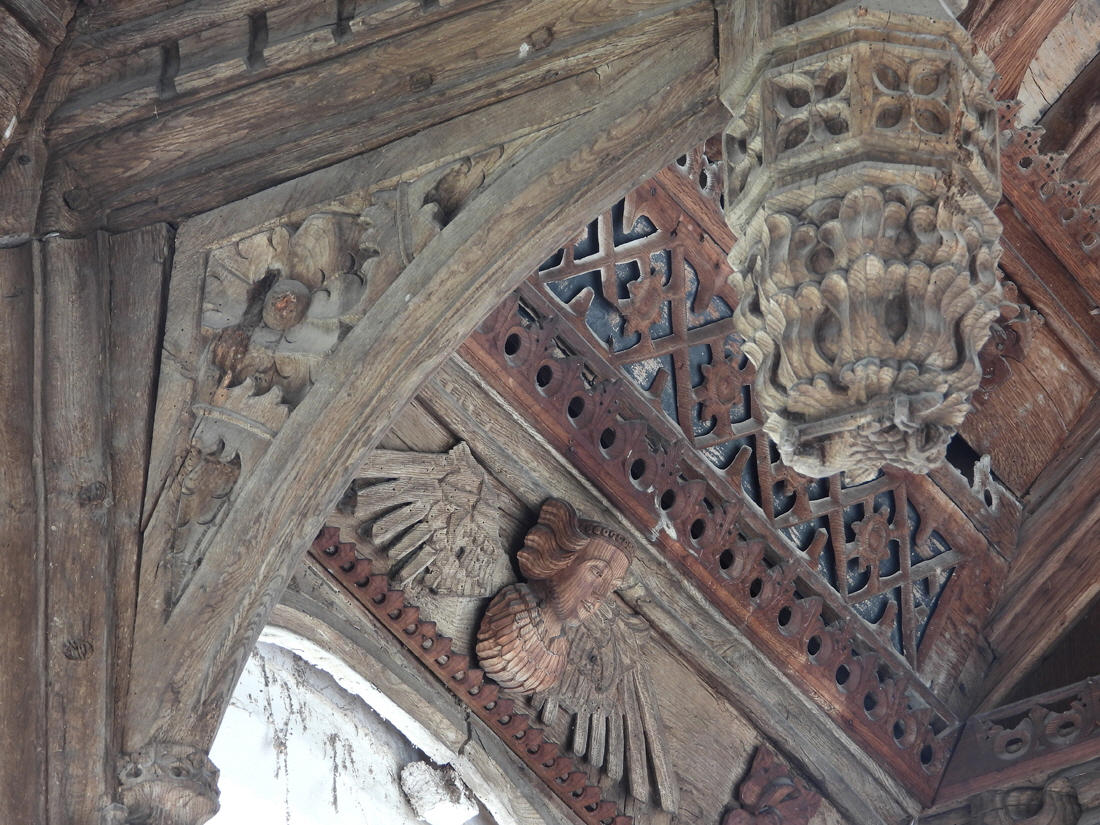
We will leave the roof with another of Bonnie’s lovely compositions. Spandrel, wall plate and pendant are all visible here. You can just see the face of a dragon facing us on the pendant clutching a weapon or a tool. Photo: BHK
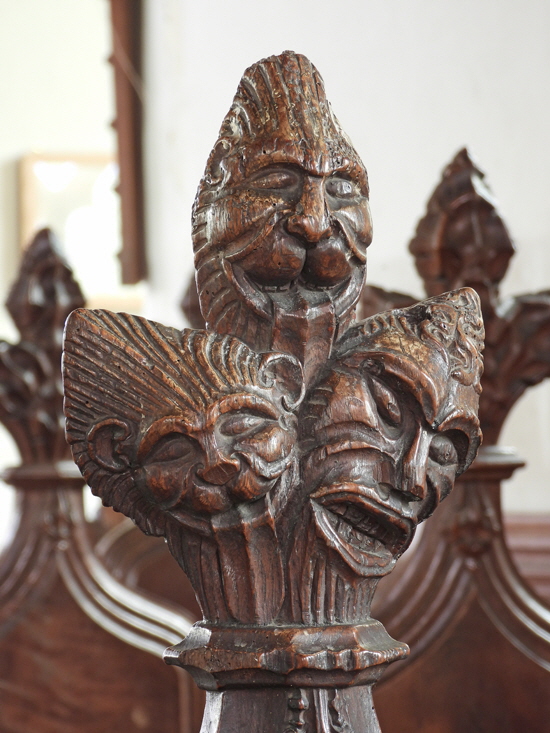
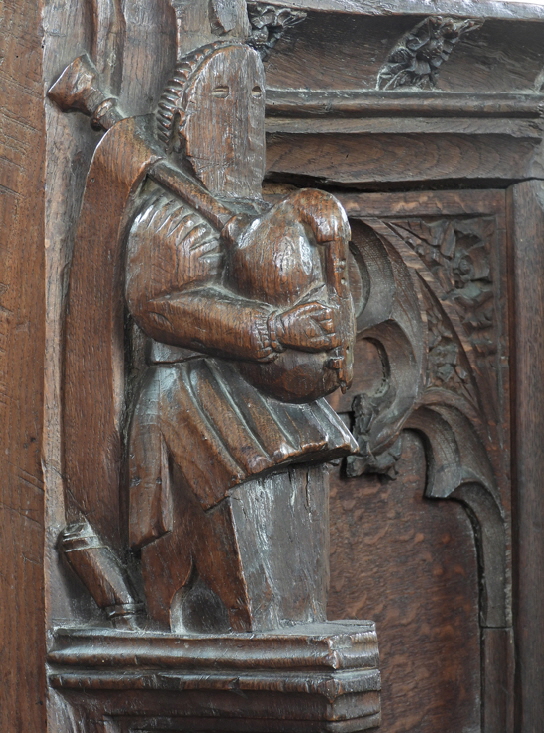
The pews within the chancel are a bit muddled, with lots of Victorian woodwork in evidence. One or two mediaeval poppy heads have survived, however,. Left: A trio of grotesque heads. Right: A bagpiper. With a bag of that size, this piper must have had quite a set of lungs on him! This is another example of inexplicable vandalism. Someone has sliced the piper’s face off very carefully. One can only wonder why? It looks like someone has subsequently gouged in a couple of new eyes. Photos: Both BHK
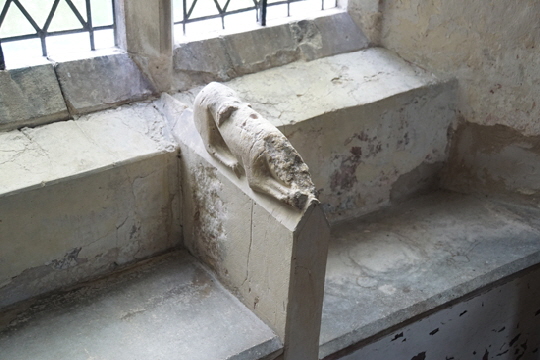
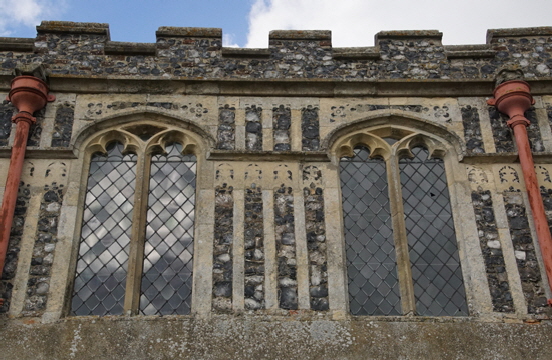
Left: There is some very basic stone seating in the chancel, in contrast with the fine triple sedilia seen in most churches. Sadly and pointlessly defaced, a maverick stonemason decided to carve (his own?) dog here. Right: An area of the south clerestory with its fine flushwork. Photos: Both LW
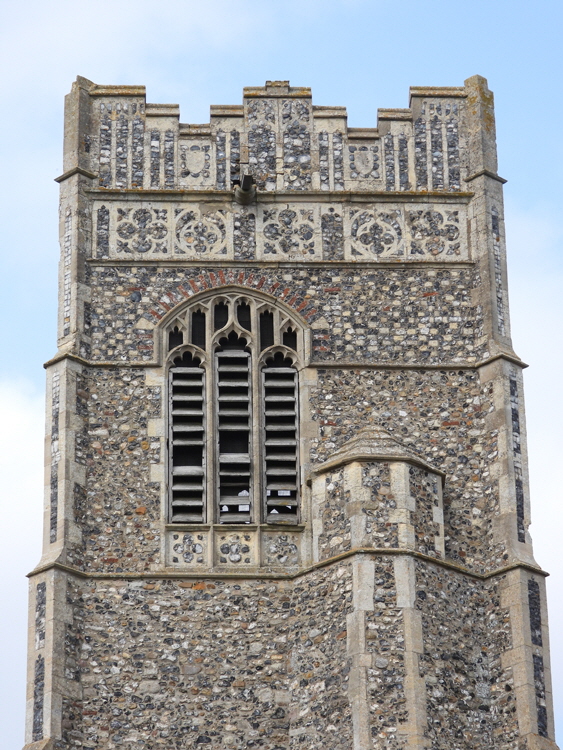
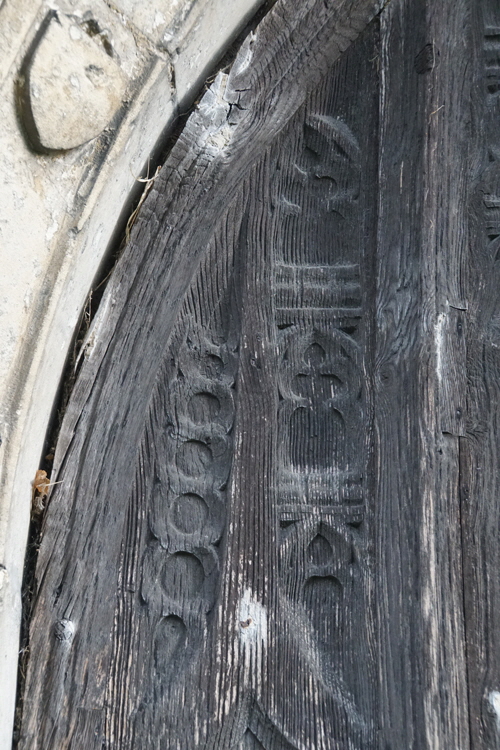
Left: The top section of the south aspect of the tower, Photo: BHK. Right: Original timber carving on the mediaeval west door. Photo: LW
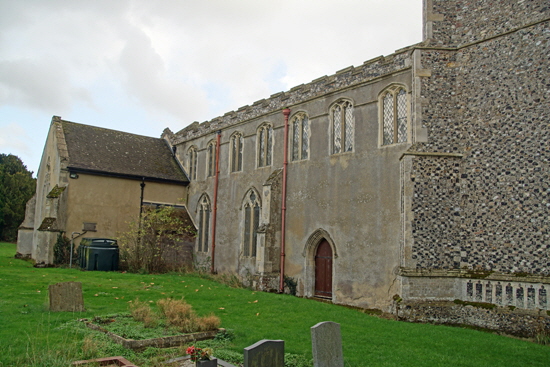
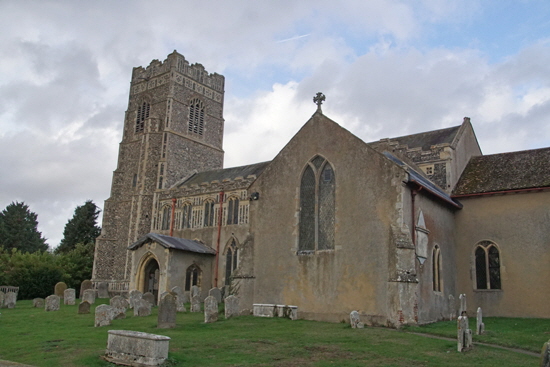
Left: I am fond of saying that not all vandals come armed with case knives and spray paint. The dreadful decision some time in the past to slap rendering on the outside of large areas of this church produced this truly depressing north aspect. Compare the clerestory area on this side with that on the south (above). Right: The church from the south east. Photos: Both LW
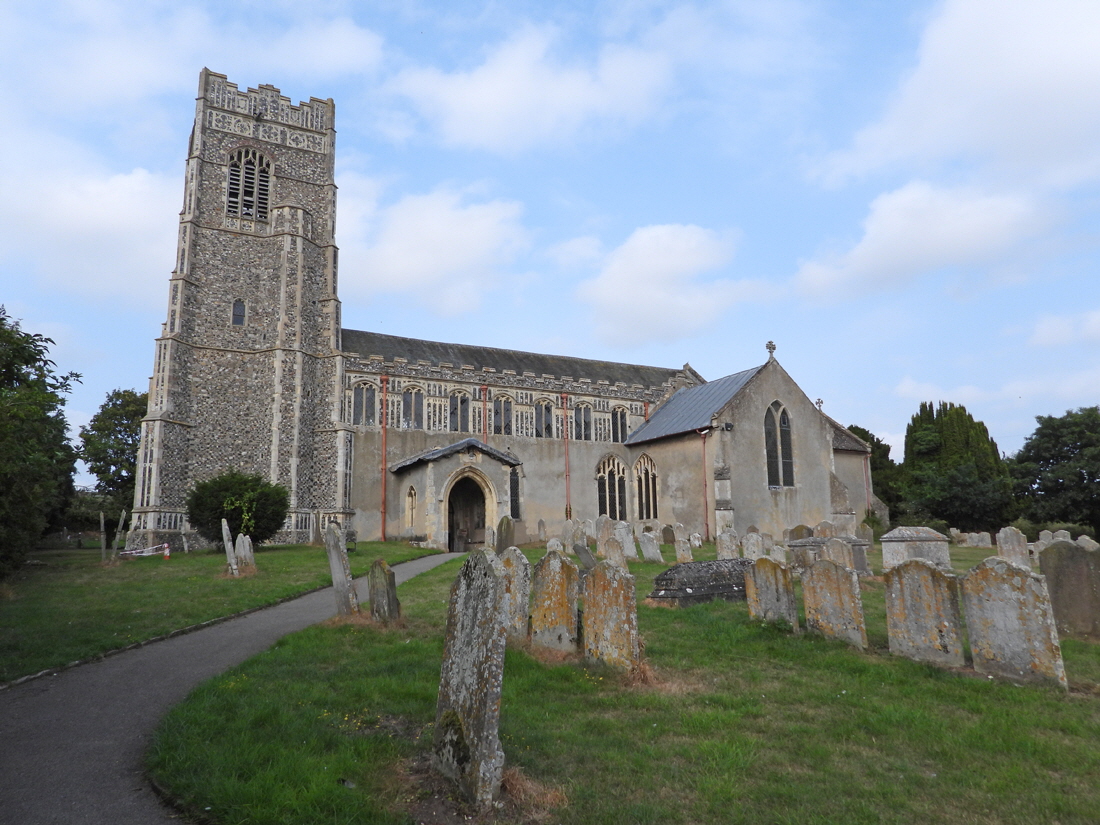
I will leave you with Bonnie Herrick-Killingback’s shot of the church from the south. The contrast between the original and the vandalised areas of the church could not be more emphatic. Photo: BHK